· The Tokatab Team · Buying Guide · 7 min to read
Our Opinion on Foldable Pianos
What to think of foldable or folding pianos that we find on the internet? Gadget, or real travel piano to take everywhere with you to practice Tokatab on the beach?
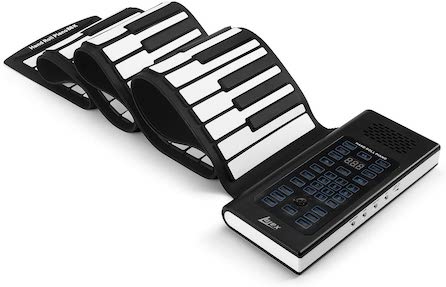
You may have seen in a store or on your favorite e-commerce site foldable pianos (or folding pianos), and you probably thought: “that looks great, I’d like to take this kind of instrument on vacation to continue working on my piano with Tokatab”. First, if that’s the case, bravo, great motivation! Next, think carefully about your need before clicking the Buy button and pulling out your credit card. You’re wondering what the best portable digital piano on the market is? Attempted answer below.
There are two types of foldable piano:
1. Flexible Foldable Pianos, or Roll-up Pianos
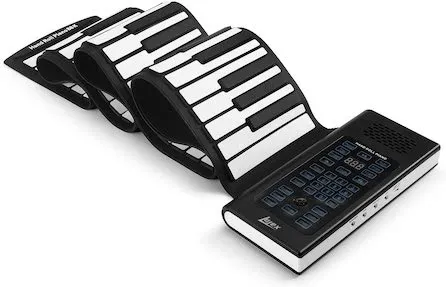
These are “roll-up” pianos, and therefore easy to transport; they come in all sizes, from 49 to 88 keys. Given the flexible nature of the keys and their thinness, such a piano will only be usable on a hard surface like a table; and abandon any idea of pianistic sensation, the keys don’t press down or very little, and the piano touch is thus very limited.
Advantages of these flexible foldable pianos:
- Relatively compact when folded: you won’t carry it in a jeans pocket of course, but can easily slip this electronic piano into a backpack or a (large) handbag while benefiting once unfolded from a fairly standard-sized keyboard
- They generally have midi & usb ports allowing them to be connected to a computer and therefore to compose or practice on a tool like Tokatab
- Their built-in battery allows playing for several hours (generally 5 to 10h), wherever you are and even without electrical outlet nearby
Disadvantages of these flexible foldable pianos:
- The touch: silicone keys press down very little and give a spongy, unpleasant touch. Sure, you can play piano anywhere, but the sensations clearly won’t be there.
- Quality / reliability: most customer reviews testify that keys sometimes respond poorly, that it’s difficult to play with two hands pressing too many keys at once. The keyboard often has difficulty detecting pressures that are too fast or presses that aren’t at the center of the key. The reliability of these keyboards seems quite relative…
- Sound quality in “synth” mode is mediocre, and you’ll probably have trouble playing in a somewhat noisy environment. To accompany someone at a party, it can help out, but you risk having trouble being heard.
Our opinion:
These flexible keyboards seem a bit gimmicky to us, more in the order of a toy than a musical instrument. If you absolutely want to buy a portable digital piano, in addition to your main keyboard, think carefully about your need first. Is it to compose in MIDI during your vacation? For this use, this type of keyboard can be of interest, due to its portability and MIDI connection. For learning or practicing piano on the other hand, it seems complicated to us to have good sensations with such a folding keyboard.
If you’re interested in this tool to make it your main piano, because you have little space at home, we recommend instead investing in a reduced-format keyboard (but non-foldable) that you can store vertically in a corner of your room or above a closet when not using it. Either a master keyboard (which will need to be connected to a third-party device to get sound), or a quality small synth.
In all cases, before any purchase of a digital piano like this, we advise you to list your constraints well (space, budget, selection criteria) because all solutions represent compromises.
What flexible foldable piano to buy?
If you really want to invest in a flexible piano, this 88-key Lujex brand piano seems to be the best value for money on Amazon. Be careful, this value for money remains quite relative, remember the disadvantages and read the reviews carefully which highlight notably numerous reliability problems.
If you’re looking for a smaller and more compact piano, this DCUKPST brand model seems well rated.
2. Rigid Foldable Pianos
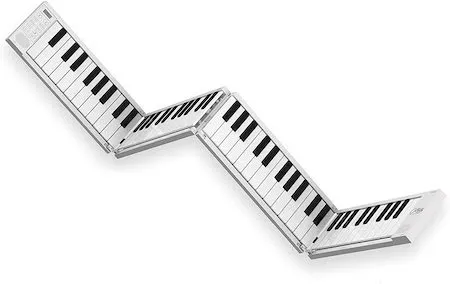
These models are logically bulkier, because instead of rolling up, they fold in sections. This ultimately gives a piano 2 to 4 times shorter (depending on the folding method) than the complete keyboard, but relatively thick nonetheless and weighing about 2kg. They’re generally found in 49 or 88-key format. Like their roll-up counterparts mentioned below, they’re equipped with a rechargeable battery as well as a speaker allowing you to play anywhere, MIDI compatibility, additional features like metronome…
The touch will be better than on a flexible piano, but remains far from a real piano; on the few models available online, we note for example that the keys aren’t weighted nor sensitive to pressure (in other words, whatever the force with which your finger presses the key, the sound produced will be the same).
Advantages of these rigid foldable pianos:
- The advantages are the same as foldable pianos: MIDI compatibility (practical for composing), built-in battery allowing you to play anywhere, speaker and headphone input, easily connectable to any external speaker
- Touch is better than on flexible pianos (while remaining mediocre in absolute terms)
- Most models include a sustain pedal / sustain pedal!
Disadvantages of these rigid foldable pianos:
- Keys aren’t pressure-sensitive
- They also produce a “typewriter” type sound when pressed, quite unpleasant
- The piano sound quality seems average, like that of flexible keyboards
- The hinge system is put to severe test with each folding and unfolding and is a fragility factor
- Switching from one sound to another requires going through all sounds one by one, in the absence of shortcut buttons.
- There’s no mechanism to keep the piano open (or closed): you must therefore play on a completely flat surface, not necessarily easy to find in a travel context for the 88-key version?
Our opinion:
These rigid foldable keyboards seem just as gimmicky to us as the flexible ones, and in any case not conducive to learning piano due to a rigid and not very musical touch. Moreover, due to their higher bulk, they’re even less transportable than the first ones and therefore less easy to take on trips; this lack of portability is compensated by a better touch than on flexible folding pianos, but not significantly.
If you’re looking for a piano for home, storage space is really a very big problem and you’re not against connecting a computer to your keyboard to play (or compose): prefer a reduced-size MIDI master keyboard like the M-audio Keystation 49
If you’re looking for a folding travel piano, to slip into a backpack or suitcase, and your need is more composition while traveling, then why not!
And if your need is to choose a real piano to learn well with Tokatab, we refer you to our buying guide for small budgets.
What rigid foldable piano to buy?
If these warnings haven’t discouraged you, you can try this 49-key model or this 88-key model (beware of the bulk of the latter, we’re in the “transportable” rather than portable domain).
A Manufacturer Set Out to Design a “Real” Quality Folding Piano
The Phoenix piano tries to solve the folding piano equation but with a much more upscale positioning and a different target. The stated ambition is to reproduce the sound and touch of a Steinway D 274 grand piano in a transportable format (you’ll need a large suitcase though).
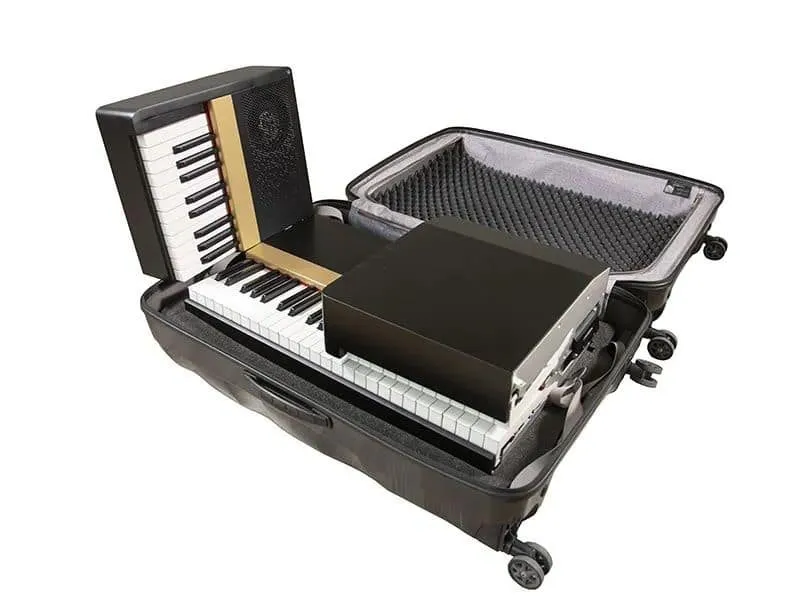
A technical feat and a beautiful project (moreover made in France), but which is more aimed at concert halls or professionals, with a price to match. Don’t hesitate to consult their site to learn more and support them if the project interests you!