· The Tokatab Team · Tips and tricks to learn piano · 8 min to read
The Tokatab Method for Learning Piano
Before creating Tokatab, we observed many aspiring pianists (it's easy, our CEO is a piano teacher...). And we designed our application and method based on these observations. Here are the pillars of Tokatab's pedagogy!
Why We Created Tokatab
At Tokatab, we’re all musicians and passionate. We know the pleasure that music can provide, whether played alone or with loved ones. We also know that learning piano may seem easy (compared to other instruments anyway), but like any learning, it requires time and energy.
Before creating Tokatab, we observed many aspiring pianists (it’s easy, our CEO is a piano teacher 😃). We also studied existing solutions for learning piano, particularly piano learning applications. The observation is a bit depressing: every year, many French people decide to take up piano, sometimes invest in equipment, but quickly face difficulties and give up before being able to truly enjoy playing the pieces they love.
Here are some problems we observed that guided our approach to designing Tokatab and developing our own piano method:
To seriously take up the instrument, the best solution remains taking piano lessons with a real teacher.
The teacher has 3 very useful tools: their eyes to see defects in your posture, the placement of your fingers, or the relaxation and position of your wrist; their ears to hear your wrong notes or lack of control over your playing speed; and their hands to give you examples, show you the solutions to find when working on a piece! In addition, the teacher has tools to help you progress, exercises and pieces to work on that will help you improve and recommendations truly adapted to your needs.
However, not everyone can benefit from piano lessons with a teacher, most often for budget or time reasons. And you might not necessarily want to be observed and corrected by a third party when you’re doing it primarily for pleasure and at your own pace, or the form of pressure of the work required that comes with weekly lessons. Taking lessons with a teacher is also an investment! It’s preferable to do it thoroughly.
Some beginner piano methods promise to make you a pianist in 2 days (and of course, in exchange for a bit of money 😀)
It’s tempting…but it’s obviously a lie. Don’t be fooled! Learning piano alone is not easy, and playing it well takes time, learning built over time while respecting the main stages. On the other hand, it’s possible to build good piano sensations in a few weeks, and to quickly have fun playing excerpts from known pieces, without having to swallow volumes of music theory and musical theory beforehand. This is what we offer you with Tokatab and our simple method to learn piano!
It’s easy to pick up bad habits when learning piano online.
Many try learning piano via applications, then realize they’re stuck and seek out a teacher. The teacher finds bad habits that have been acquired and that are difficult to change: bad posture, inappropriate finger positions, lack of mastery of basic techniques, poorly used pedal…We won’t tell you that in some cases the flaws are irreparable, let’s not be musically alarmist, but sometimes going back to rebuild everything will be long and impossible to do alone.
The tutorials you can find on YouTube are pleasant at first but end up demotivating
It’s of course possible to learn piano online by playing pieces with YouTube. You can even have fun quite quickly. However, you’re left to yourself, there’s no long-term support that helps remotivate and overcome difficulties when they appear. These difficulties, YouTube content providers can’t know them… And we’re often told that spending time pausing and rewinding videos in a loop isn’t very practical!
Some piano learning applications are more game-like than musical.
Difficult to get quality fingerings. Sometimes they’re not noted. What’s more, many applications favor “note-by-note” learning, without necessarily accompanying the user in mastering piano techniques, gestures. You’re congratulated for having managed to press the keys in the right order, but that’s not playing piano! For us, the important thing is not to make you earn stars or points but to allow you to sit at a piano and play pieces you love with both hands.
We design Tokatab to respond to all these problems, and help each of you to finally (re)start piano!
The Pillars of the Tokatab Method
Transparency
We don’t sell you miracles or magic methods that will make you a complete pianist in a few days or a virtuoso in a month. Progressing at piano can be long and requires regular work over the medium term; but it’s so magical that it’s worth it!
What we offer with Tokatab: a method that allows you to really measure your progress, feel it in your hands, in your fingers, and be accompanied at each stage to overcome the inevitable difficulties. In short, benevolent support, a virtual teacher who doesn’t sell dreams but will help you progress concretely over time.
Serious Learning But Without Taking Yourself Too Seriously
Tokatab is an app to truly learn piano, and not just to play 3 or 4 songs by “stupidly” repeating notes one by one like in a video game.
Our innovative pedagogical method, developed in partnership with CNRS, is designed to develop real solid foundations on piano, while having fun quickly via small excerpts or entire application pieces! In a few days you’ll be able to play a real piece, adapted to your level and using the concepts and playing techniques adapted to your level. We offer simplified arrangements allowing you to play interesting and known pieces even if you’re a beginner, and as you progress you’ll gradually be able to play original versions of more complex pieces. Tokatab will also allow you to learn the main gestures and rhythms of accompaniment piano with pieces and exercises to train you to accompany third parties who sing or if you wish to sing and accompany yourself on piano later.
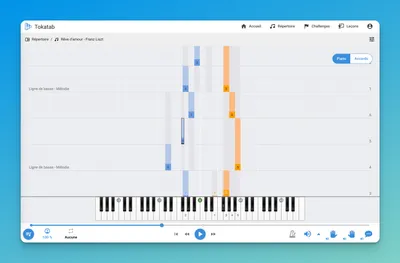
Finally, there’s no need to know music theory to play on Tokatab. Our “tablature” type representation mode allows you to progress even if you don’t know the notes.
Personalization
If you took piano lessons with a teacher, they would identify your strengths and weaknesses and offer you exercises and pieces accordingly, adapted to your level and goals. We cannot and do not wish to compete with piano teachers (we’re transparent 🙂), but Tokatab’s innovative technology helps us offer you ultra-personalized learning inspired by that provided by a real teacher.
Forgotten are YouTube tutorials where you have to pause and rewind dozens of times to decipher and learn a passage. From the first minutes on Tokatab, we build a personalized progression path, and it constantly adapts to your progress and successes to allow you to learn piano easily. You need to work on a new technique like a thumb pass or a type of chord for example? We’ll offer you the right exercise. You just played a piece for the first time? We’ll offer you others calling on the same skills, to strengthen them.
Our recommendation engine, which could be compared to a virtual coach, is programmed to help you progress constantly, without getting discouraged by difficulties.
A Repertoire That Aims for Quality Rather Than Quantity
Is it really useful to have access to 1,000,000 pieces, often with a majority of poorly arranged versions, not practical to play or even impossible to decipher because without indicated fingerings, with both hands mixed, with wrong notes? At Tokatab, we focus on a classical piano repertoire that allows you to lay the foundations and build skills to play piano well: but our goal is to build bridges with a pop/modern repertoire that we’ll develop over time. Indeed, many techniques you’ll learn with Chopin, Beethoven, or Mozart will allow you to play the Beatles or Lady Gaga later (music is like cooking, many recipes are very good and have delighted us for centuries)! Our technology can identify these techniques, and offer you the piece most suited to your level and tastes whatever its style.
Each of our pieces is carefully arranged, sometimes in several versions to allow you to play them whatever your level while learning new things on piano. We’re certain you’ll find what you’re looking for in our catalog.
By Heart
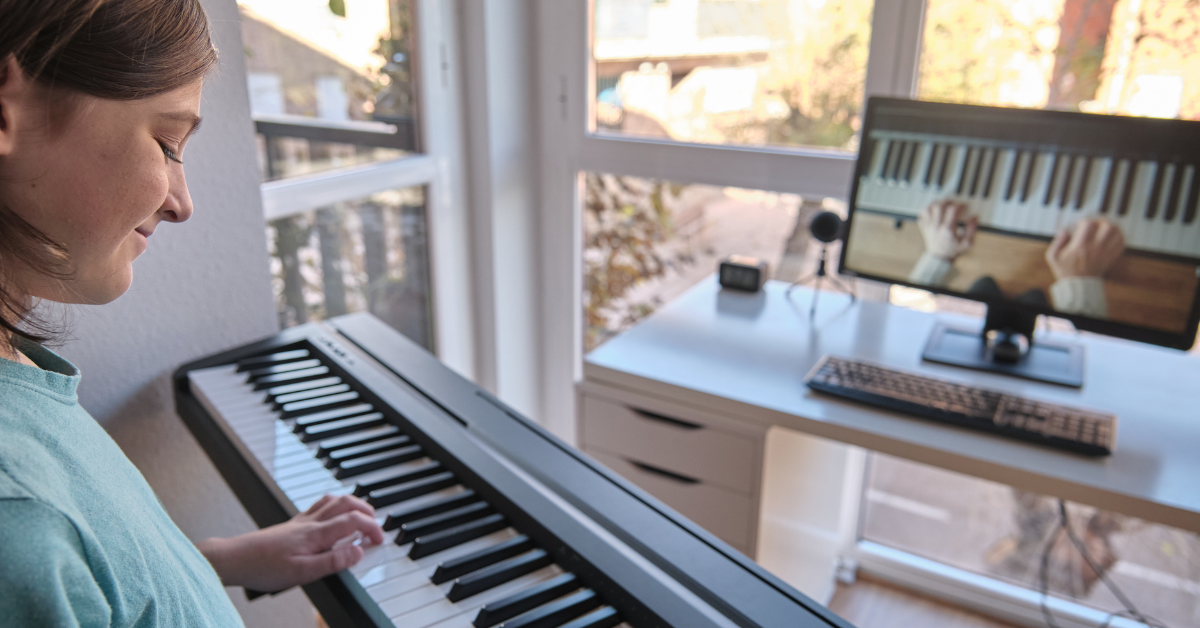
Playing in front of your screen is necessary to decipher the score on Tokatab (the application is available on mobile, tablet, and laptop!). But once the learning phase is over, it’s still nicer to focus on the piano. On the sound. On the sensations. Our goal is for you to know how to play each of our pieces alone, by heart, without the support of your smartphone. The next time you find a piano in a train station or at friends’ houses, you’ll be able to have fun without draining your phone’s battery 😉
Accessible
Because music is a common good, that everyone should have access to piano, our offers are designed to allow you to learn piano alone, without breaking your budget. Tokatab is even inexpensive enough to be used in addition to a piano teacher!
We also care about offering content both to those who don’t know music theory (via a simplified representation) and to those who already master it (those more savvy in music theory will quickly find their bearings and can choose to display note names on the keys to use or soon activate a tablature mode).
In short, whatever your level, your piano practice, your goals, Tokatab has been designed for YOU and our pedagogical method adapts to you! To try it, it’s simple and free, and it’s here.
Illustration images generated by Dall-E.