· The Tokatab Team · Tips and tricks to learn piano · 9 min to read
How to Progress Quickly on Piano as a Beginner
In this article, we'll guide you step by step, with concrete advice adapted to beginners. The goal: allow you to progress effectively while keeping the pleasure intact. Ready to take this first step? Then, follow the guide!
Adopt a Structured Method for Your Learning
One of the main mistakes beginners make is wanting to skip steps. You start with enthusiasm, dreaming of playing your favorite pieces from the first weeks, but quickly, frustration can set in if you don’t get the expected results. This is where a progressive learning method becomes essential.
Why Following a Step-by-Step Progression is Essential
Imagine a hiker venturing onto a mountain without an itinerary. They risk getting lost, wasting energy and, ultimately, giving up before reaching the summit. Learning piano is a bit the same: each skill rests on mastering the fundamentals. For example, before playing complex pieces, you must first acquire solid foundations, such as note recognition, posture, and rhythm control.
By following the recommendations of our virtual coach, restructure your sessions by alternating between technical exercises and musical practice. In a few weeks, you’ll be able to notice a clear improvement in your playing and especially your fluidity.
Using an Application Like Tokatab to Structure Your Lessons
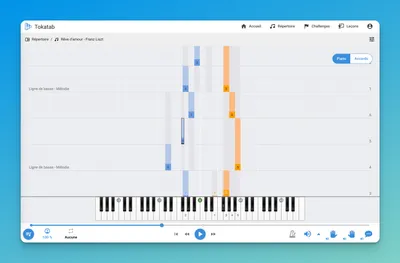
The Tokatab method prevents you from scattering and guides you step by step. The application offers you a progressive path adapted to your level. You start with simple exercises to familiarize yourself with the keys and rhythm. The virtual coach then analyzes your performances in real time: if you play too fast or if your notes lack precision, it indicates this directly on your playing.
Tokatab allows you to learn completely independently while benefiting from immediate feedback, which is essential for progressing quickly.
Examples of Structured Exercises
Here are some suggestions for organizing your piano sessions:
- Warm-up (5 minutes): mobility exercises for the fingers.
- Technique (10 minutes): work on scales or basic chords.
- Pieces (15 minutes): decipher a new piece or perfect a difficult passage.
Set Clear and Realistic Goals
The key to progression is having clear and realistic goals. First decide what you want to achieve: play a particular piece, improve your technique…? Then, divide this goal into steps.
Why Are Goals Essential?
A well-defined goal allows you to focus your energy on measurable steps that will motivate you. For example, if your goal is to play a jazz piece, it may seem intimidating at first. Yet, by breaking down this goal into sub-goals, everything becomes more approachable:
- This week, learn the right hand of an easy piece.
- Next week, add the left hand.
- Within a month, aim for a first complete interpretation with left and right hands.
This allows you to notice your progress at each milestone achieved, which reinforces your confidence.
The Advantages of the Tokatab Approach
Thanks to our application, you benefit from structured accompaniment. The virtual teacher analyzes your performances and guides you step by step. Each goal is followed by specific exercises to make you progress without skipping steps.
Practice Regularly, But Intelligently
No need to spend three hours a day playing if you’re not focused. Prefer short sessions (20 to 30 minutes) but regular, where you’re totally invested. What’s important is the quality of your practice!
What to Focus On?
- Target difficulties: Don’t just replay passages you already master. Focus on the parts that pose problems, working on them slowly and breaking down each movement.
- Vary exercises: Alternate between technique (scales, arpeggios), interpretation (pieces), and theory (reading scores). This stimulates different skills and enriches your learning.
- Plan session goals: For example, start a session by deciding in advance to work only on a complex transition or a difficult rhythm.
How Tokatab Optimizes Your Practice?
With Tokatab, you’re never alone in front of your keyboard or dozens of YouTube videos among which you don’t know what to choose. Our virtual coach tracks your progress and detects your weak points. Based on your performances, the application offers you targeted exercises to strengthen your skills. No more useless repetitions: each minute of your practice is designed to make you progress concretely. Plus, you can activate reminders to stay regular and avoid interruptions in your learning.
Focus on Technical Basics
Learning piano without mastering the basics is like building a house without solid foundations. You quickly risk finding yourself blocked by clumsy gestures, irregular sound or repetitive errors.
- Work on Posture and Hand Position
Many beginners sit at the piano without paying attention to their posture, which can quickly lead to pain or fatigue. Good posture not only avoids these inconveniences, but also allows you to better control your movements.
Here are some simple benchmarks:
- Seat height: Your elbows should be slightly above the keyboard. If your seat is too low, you’ll tend to slump, which causes tension. Too high, you lose the necessary flexibility in your wrists.
- Feet well anchored to the ground: Your feet should stay flat, to offer a stable base to your body. This allows you to keep balance while comfortably accessing the pedals if necessary.
- Shoulder and wrist placement: Keep shoulders relaxed, neither raised nor tense. Wrists should be aligned with the keyboard, neither too raised nor too low.
- Distance from keyboard: Sit at a distance where your arms can play without tension. If you’re too close, you’ll be forced to lean; too far, you lose control.
Tokatab integrates practical advice on posture via videos. Regular messages encourage you to check your position. Thanks to explanatory videos from our qualified teacher Florent, you learn to adjust your posture independently, which allows you to prevent tension and play more comfortably.
Master Scales and Basic Chords
Scales and chords constitute the foundations of music. They improve the flexibility of your fingers, develop your musical ear and help you anticipate the structures of pieces. Even if scale exercises may seem repetitive, they allow you to strengthen your automatisms and feel more comfortable on the keyboard.
Start with major scales, like C major, which only includes white keys. Once you master it, you can explore other tonalities, progressively adding sharps or flats. For chords, first learn simple triads (C major, A minor), then work on their inversions.
A tip: integrate scales into your daily warm-ups. For example, play a scale by progressively increasing speed while maintaining regular touch. This stimulates both your precision and coordination.
Don’t Neglect Rhythm Work
Rhythm is a fundamental pillar of piano playing. To avoid interpretation errors, it’s useful to train with a metronome or exercises offered by Tokatab. They help you maintain a constant rhythm and develop your ability to play in synchronization with a precise tempo.
Diversify Your Exercises
Always repeating the same scales or pieces can become tedious and slow your motivation. Alternate between several types of exercises: scales, arpeggios, reading scores and improvisation. This stimulates different skills and makes your practice more dynamic.
What Types of Exercises to Vary?
To progress in the best conditions, alternate between several categories of exercises:
- Scales and arpeggios: These technical exercises develop finger flexibility and coordination.
- Reading scores: To improve your ability to quickly decipher new pieces.
- Musical interpretation: By focusing on expression and phrasing, you learn to bring each piece to life.
- Improvisation: It strengthens your creativity and mastery of harmonies. It can also make your sessions more fun.
- Rhythmic exercises: Working on complex passages with rhythmic variations helps you refine your precision.
Example Session Plan
Imagine a 30-minute session:
- 5 minutes of scales varying tonalities.
- 10 minutes dedicated to learning a new technical passage.
- 10 minutes of work on interpreting a piece.
- 5 minutes for free improvisation or rhythmic review.
This alternation keeps your fingers, brain and musical ear stimulated throughout the session.
How Tokatab Accompanies You in Exercise Diversity?
Our virtual teacher offers you adapted lessons that combine technique and interpretation. Exercises are adapted to your level and evolve with your progression. You thus benefit from rich and stimulating learning, avoiding any feeling of routine.
Use Tokatab to Accelerate Your Learning
The era when we depended solely on in-person teachers or score manuals is over. Today, digital tools revolutionize piano learning by making practice more interactive and effective. Tokatab is an excellent example, combining pedagogy and technology to accompany you daily.
Discover the essential resources of Tokatab to progress on piano.
Listen Mode and Automatic Performance Analysis
Tokatab’s listen mode is an innovative feature that transforms your phone, tablet or computer into a true communication tool with the virtual coach. Thanks to this mode, the application is capable of listening to the notes you play to analyze your performance in real time and give you feedback and suggestions afterwards. If you play an incorrect note, if your rhythm is irregular or if you forget a passage, the virtual coach detects it, signals it to you and suggests you retrain on the passage in question.
This feature allows you to progress faster by giving you continuous feedback. You don’t make the same mistake in a loop without realizing it… which makes your practice sessions much more productive.
Metronome and Work Tempo
Rhythm is a fundamental aspect of piano. Many beginners get carried away by the melody and lose the regular pulse of the piece. The metronome is an indispensable tool for stabilizing your tempo. With the help of the metronome and feedback on your playing, Tokatab guides you on tempo management during your work sessions on exercises or pieces.
Tracking Your Progress
Learning an instrument is a journey marked by small victories, but also moments of doubt. It can be difficult to perceive your progress daily. That’s why it’s essential to have a tracking system that objectively shows you your advances.
With Tokatab, you can consult your practice statistics: number of pieces learned, time spent on the instrument, and improved technical points and especially acquired skills or ones to review! This personal tracking allows you to notice the evolution of your level and stay motivated.
Conclusion
By adopting a progressive and structured approach, practicing regularly and consolidating your technical bases, you put all the chances on your side to advance quickly.
Tokatab accompanies you at each step of your progression thanks to features designed to meet the needs of beginner as well as experienced pianists. You benefit from a virtual coach that analyzes your performances in real time, helps you correct your mistakes and offers you a personalized path. Plus, you can access a large library of pieces, exercises and challenges to progress quickly!
Ready to take your first steps on piano? Try Tokatab for free and without commitment.