· The Tokatab Team · Tips and tricks to learn piano · 7 min to read
Left Hand Syndrome: How to Improve Hand Independence on Piano?
You've probably already experienced this scene: you start a piece, your right hand plays with ease... but your left hand, it seems as reactive as modeling clay that's too dry. This phenomenon has a name: left hand syndrome. We reassure you, it's not inevitable.
You’ve probably already experienced this scene: you start a piece, your right hand plays with ease… but your left hand, it seems as reactive as modeling clay that’s too dry!
This phenomenon, common among beginning pianists, has a name: left hand syndrome. We reassure you, having experienced it ourselves for some of us, it’s not inevitable.
The lack of coordination of your hands or ease of the left hand shouldn’t stop you. With the right method and targeted exercises, you can develop the independence of your two hands and play with more confidence. Thanks to Tokatab’s practical approaches, our experts’ advice and our personalized tools, you’ll discover that coordination at the piano is accessible to everyone. Follow the guide!
1. Why Does the Left Hand Pose a Problem at Piano?
A Difference in Roles That Complicates the Task
When you play piano, your hands don’t have the same responsibilities. The right hand, often more active, interprets the main melody. It immediately captures your attention, because it’s what brings the piece to life. The left hand, on its side, plays a more subtle role: it supports the whole by ensuring harmony and rhythm through chords.
If the left hand isn’t mastered, your entire piece will lose its balance. Yet, many beginners concentrate more on what the right hand does, neglecting the left hand’s work, which ends up creating imbalances in the interpretation…
A Cerebral and Motor Challenge
This difficulty also comes from the way our brain controls our movements. Each hand is linked to a different cerebral hemisphere: the left hemisphere for the right hand and vice versa. If you’re right-handed, it’s likely that your left hemisphere is more active and better trained, which makes your right hand naturally more skillful and fast. The left hand, on the other hand, can seem less precise or more difficult to coordinate.
Add to this the fact that our daily gestures often favor the dominant hand. Few activities, outside of music, require simultaneous and independent control of both hands. So it’s an entirely new learning for your brain. But rest assured: every pianist, even the most experienced, has gone through this stage.
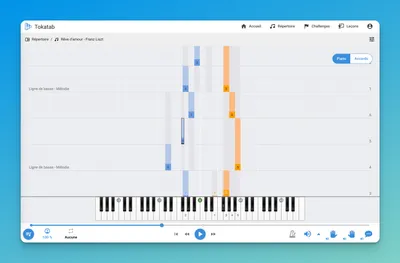
With Tokatab, we help you get through this stage. Thanks to the virtual teacher, you benefit from exercises adapted to your level, which allow you to work your hands in a balanced way, separately but also together of course. Progress analysis helps you target points to improve, while motivating you to persevere. Moreover, our technology allows you to isolate the right hand or left hand on any piece in order to train effectively.
Now that you understand the origins of this problem, let’s move on to concrete exercises to strengthen the independence of your hands at piano.
2. Basic Exercises to Improve Hand Independence
Hand independence is an essential skill for playing piano with fluidity. To achieve this, it’s necessary to progressively integrate targeted exercises into your learning routine. Here are some techniques from our experts to practice regularly to overcome the famous “left hand syndrome.”
Work on Scales Hands Separately Then Together
Scales are an excellent way to get your hands used to coordinating. Always start by playing them separately to memorize the movements. Once comfortable, move on to a hands-together exercise:
- Step 1: Play a simple scale, like C major.
- Step 2: Synchronize your hands by focusing on finger crossings (thumb passage is often a challenge).
- Step 3: Vary rhythms (slow, moderate, fast) to strengthen your control.
Our experts’ advice: don’t try to go too fast at first. Precision is more important than speed! Use our listen mode which displays errors in notes in real time to correct them instantly.
Play Chords in Left Hand with Stable Accompaniment
Another fundamental exercise consists of stabilizing the left hand by having it play basic chords. This helps you keep a constant rhythm while allowing the right hand to express itself freely.
- Exercise: Play a simple chord (for example, C major) in a loop with the left hand. Meanwhile, improvise or play a melody of your choice with the right hand.
- Variant: Change chords as you go to train the flexibility and reactivity of the left hand.
This prepares you to play pieces where the accompaniment must remain solid and regular, even if the right hand varies.
Take advantage of our free chord dictionary to find beautiful chords.
Use Tokatab for Interactive Exercises
The Tokatab application offers exercises dedicated to working on each hand and working on hand independence from complete novice to more advanced. Thanks to the virtual coach, you’re guided step by step, with real-time analyses of your performances. This allows you to quickly correct your errors and progress at your own pace, without pressure.
3. Practical Tips to Overcome Left Hand Syndrome
Developing hand independence at piano doesn’t happen in one day, we confirm it! To overcome left hand syndrome, it’s essential to adopt simple but effective goals, which will help you progress gently while keeping your motivation intact.
Practice the Left Hand as Much as the Right Hand!
The most common mistake is to work the right hand much more than the left hand because it’s often the one that plays the most interesting parts. Moreover, being mostly right-handed, the right hand is more pleasant to practice because more comfortable. So you must ensure not to neglect the left hand and spend sufficient time for it to gain ease.
- Try to always make your left hand work at each playing session, even if it means replaying a passage you already play very well. It’s also very beneficial for seeking and finding good sensations with this hand.
- Continue working on a passage as long as it doesn’t seem “easy” to you.
Tokatab’s virtual coach is programmed to recommend the right exercises at the right time, including advising you to change hands when it detects you’ve been playing with the same hand for a long time.
Practice Slowly and Progressively
Another mistake is wanting to play too fast from the start. However, lasting learning requires mastering movements at slower tempos.
- Start by playing difficult passages slowly while focusing on controlling each hand.
- Increase speed only when you feel perfectly comfortable.
Work Regularly Rather Than Long
Regularity is more beneficial than an occasional long session. The brain better assimilates repetitive gestures with short but frequent practices.
- Give yourself at least 10 to 20 minutes per day to work on hand independence.
- Don’t hesitate to take breaks or alternate with lighter exercises.
Tokatab allows you to organize your sessions thanks to personalized routines that take into account your goals and your progression on your profile.
Use Pieces Adapted to Your Level
It’s essential to choose accessible pieces to avoid discouraging yourself. A piece with too complex accompaniment from the start risks reinforcing tension in your left hand.
- Start with simple pieces featuring repetitive chords or arpeggios.
- For example, pieces like “Au Clair de la Lune” or exercises from Czerny’s repertoire are perfect for working on coordination.
With Tokatab, you have access to a wide choice of pedagogical pieces classified by difficulty. Our virtual coach also offers you challenges adapted to your progression.
Work Each Hand Separately Before Synchronizing Them
Training your hands separately allows you to better anticipate their respective movements. You’ll then know exactly what each hand must do before bringing them together.
- First play the melody alone with the right hand, then the accompaniment with the left hand.
- When you feel comfortable, combine both while ensuring to keep a stable rhythm.
Tokatab offers interactive scores where you can choose to isolate each hand and progress at your own pace.
By applying these tips daily, you’ll quickly notice an improvement in your mastery of the left hand.
Conclusion
Developing hand independence at piano is an unavoidable challenge, but accessible to all with patience and well-structured practice. By taking the time to work on each hand separately, using adapted exercises and adopting a regular routine, you’ll end up playing with more ease and fluidity.
Don’t forget that you’re not alone in this journey. With Tokatab, you benefit from personalized accompaniment, varied pieces and a virtual coach to analyze your progress. Start today with our free trial period and without commitment.