· The Tokatab Team · Tips and tricks to learn piano · 9 min to read
Learning to Play Boogie Woogie Piano
Like Reggae, salsa, or blues, boogie woogie is a complete musical style with a vast repertoire, pieces of all levels, and piano techniques that are unique and typical to this style, giving it a strong identity. When you play a wild boogie woogie, you can be sure that people listening to you won't be able to help but smile, tap their feet, and eventually dance if you keep the tempo! In this article, we'll discuss the origins of Boogie Woogie and the reasons why it's a great musical style to work on at the piano.

The Origins of Boogie Woogie

Boogie Woogie is an energizing and rhythmic musical genre that emerged in the Southern United States in the early 20th century. Its origins trace back to African-American work songs in the plantations, where syncopated rhythms were used to accompany laborious tasks. Pianists in bars and cabarets in New Orleans then incorporated these rhythms into their improvisations. Over time, Boogie Woogie gained popularity, spreading to dance halls and clubs across America. In the 1920s and 1930s, Boogie Woogie piano recordings achieved great success, notably with musicians like Pinetop Smith and Jimmy Yancey.
Why is it Great to Work on Boogie Woogie at the Piano?
You’ll Strengthen Your Left Hand
In Boogie Woogie, one of the great challenges is the left hand! Indeed, it plays a fundamental role as it constitutes the essential rhythmic element that defines this musical genre. Working on Boogie Woogie will allow you to extensively engage and strengthen your left hand. Several techniques characterize the left hand in Boogie Woogie:
- Bass ostinato: The left hand establishes a repetitive rhythmic pattern, generally based on 12-bar chord progressions typical of blues. These bass patterns are played with a regular and constant rhythm, creating a solid foundation for the music.
- Thumb beat: A common technique in Boogie Woogie is the “thumb beat” (or “thumbing”). This consists of playing the bass with the thumb while alternating between different bass notes to create a looping pattern. This beat gives a sense of energy and incessant movement.
- Syncopation: The left hand in Boogie Woogie often uses syncopation to accent certain weak beats, creating an irresistible swing. This syncopation gives a dynamic and lively character to the music, often prompting listeners to sway and dance.
- Walking bass: Sometimes, the left hand adopts a technique called “walking bass” where it plays more elaborate bass lines, creating a melodic progression effect. This adds complexity to the music and allows pianists to vary their playing.
- Dialogue with the right hand: The left hand interacts closely with the right hand, creating a cohesive musical dialogue. While the right hand improvises melodies and variations, the left hand continues to maintain the rhythm, thus forming a harmonious combination.
- Rhythmic variations: The left hand also offers improvisation possibilities by bringing rhythmic variations to the bass pattern. Pianists can play with rhythms, syncopations, and accents, adding a personal touch to their interpretation.
You’ll have understood, the left hand is the rhythmic backbone that brings Boogie Woogie to life, making this music an intoxicating pleasure to listen to and play!

You’ll Also Enrich Your Right Hand Technique
In Boogie Woogie, the right hand plays a role just as important as the left hand! It’s the hand that brings the melodic elements, variations, and improvisations that enrich the piece. Here’s an overview of the right hand’s role in Boogie Woogie. Several things characterize the right hand’s role in Boogie Woogie:
- “Cliché” melodic phrases: The right hand is responsible for melodic playing, exploring different scales and patterns while relying on the harmonic context created by the left hand. Often, you’ll play melodies with patterns close to those of blues and jazz, clichés of these styles. You’ll therefore gain ease in these two styles as well.
- Syncopated melodies: Your right hand must play syncopated melodies, meaning it must accent certain weak beats and off-beats to add swing and liveliness to the music. These syncopations intertwine with the left hand’s rhythmic patterns, creating an animated musical dialogue and forcing you to develop your rhythmic ease and hand independence.
- Use of octaves: Boogie Woogie pianists frequently use octaves in the right hand to enrich the sound and add power to their playing and melodies. Playing melodies in octaves gives a distinctive and punchy sonority that makes the audience vibrate and which is also a common technique in classical and pop piano. It’s one of the key and complex techniques, sometimes to work on and master at the piano.
- Trills: The right hand can also add trills between melodic phrases, adding ornaments and additional nuances to the piece. Playing trills consists of rapidly alternating between two close notes. Mastering trills at the piano requires good coordination between the fingers, speed, and a certain flexibility. Pianists must train regularly to develop this technique and apply it fluidly and expressively in their musical playing.
In summary, the right hand in Boogie Woogie is responsible for melodic improvisation, adding syncopations, using octaves and fills, as well as harmonious dialogue with the left hand.
In fact, the magic is created by both hands together! They both have very different roles which implies having good independence between them. The foundation that the left hand must represent must not be disturbed by the melodic and rhythmic flights of the right hand.
You’ll Challenge and Develop Your Endurance
Endurance plays a crucial role in performing Boogie Woogie at the piano! Because the rhythm of this music is fast and sustained, with repetitive patterns in the left hand and energetic improvisations in the right hand. It’s very difficult not to tense up when playing repetitive patterns on the piano, and to maintain the necessary relaxation to play for a long time, this type of music requires training and a very sound technical foundation… No one would imagine putting a Formula 1 engine in a 2CV and pressing the accelerator all the way…
How to play Boogie Woogie piano successfully? Pianists must indeed develop excellent physical and mental endurance.
Here are some aspects where endurance is essential in Boogie Woogie:
- Pattern repetition: The left hand often plays repetitive bass patterns throughout the piece. To maintain a constant and solid rhythm, the pianist must be able to play these patterns without weakening or tensing up, which requires endurance in the finger and forearm muscles and a permanent ability to stay as supple and relaxed as possible.
- Fast playing: Boogie Woogie often requires rapid playing passages, with notes played in quick succession. This can be exhausting for the fingers and wrists, and endurance is necessary to maintain fluidity in playing even during the fastest parts.
- Hand coordination: Boogie Woogie requires advanced coordination between the left and right hands, as they play independent but complementary patterns. From this point of view, this coordination requires mental endurance to stay focused on both hands throughout the piece.
Specific exercises can be used to strengthen the finger and hand muscles, as well as to improve playing speed and precision.
It’s also important to warm up before playing to avoid injuries and excessive fatigue, just like for other musical instruments and other styles when working a lot on music.
Which Pieces to Start With for Boogie Woogie?
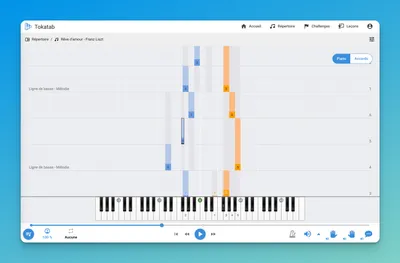
On Tokatab, piano enthusiasts and Boogie Woogie lovers can now discover the captivating musical universe of boogie woogie and learn this rhythmic art through a collection of pieces in this style, carefully arranged and offered on the application. They are specially designed and arranged for the progress of learners who want to develop their playing consistently and coherently.
You can also find online several pieces that are often used to begin boogie woogie at the piano:
- “Boogie Woogie in C”: Start by learning a boogie woogie in the key of C major (C). This piece is generally simple and uses repetitive bass patterns; in itself, it’s a very common tune taught to beginner piano students!
- “Pine Top’s Boogie Woogie”: This piece, composed by Pinetop Smith, is a Boogie Woogie classic often taught to beginner pianists due to its characteristic bass patterns and catchy melody.
- “Honky Tonk Train Blues”: Written by Meade Lux Lewis, this piece is another Boogie Woogie essential. It features walking bass patterns and a catchy melody, making it a good option for beginners looking to develop their hand coordination.
- “Cow Cow Blues”: Composed by Cow Cow Davenport, this piece is also a good introduction to Boogie Woogie with simple bass patterns and a melody accessible to beginners.
- “Swanee River Boogie”: Composed by Albert Ammons, this is a Boogie Woogie arrangement of the famous song “Old Folks at Home” (also known as “Swanee River”). It offers a blend of familiar melodies and bass patterns characteristic of Boogie Woogie.
The Best Current Boogie Woogie Pianists!
Great boogie woogie pianists have left us and marked their era. We decide here to focus on those who are still very much alive and determined to make us move our heads for hours every time they get on stage.
Here are 4 Boogie Woogie pianists among our favorites:
- Luca Sestak: Luca Sestak, from Germany, is a prodigious Boogie Woogie pianist who has impressed audiences from a very young age. His energetic and enthusiastic playing has attracted the attention of many Boogie Woogie fans; he is simply brilliant! Especially in this video: Luca Sestak - Joogie Wazz (Live).
- Jean-Pierre Bertrand: A French pianist, Jean-Pierre Bertrand is an ambassador of Boogie Woogie in Europe. His dynamic and expressive style has earned him a solid reputation among lovers of this musical genre. Jean Pierre Bertrand - 2019 San Francisco Boogie Woogie Festival.
- Jools Holland: A British musician and television presenter, Jools Holland is also an accomplished Boogie Woogie pianist. He has helped popularize this musical genre to a wide audience. Jools Holland & his R’n’B Orchestra - One O’Clock Boogie (Jools’ Annual Hootenanny 22/23).
- Silvan Zingg: A Swiss pianist, Silvan Zingg is another modern Boogie Woogie virtuoso who has traveled the world to share his passion for this energizing music. Silvan Zingg - Pinetop’s Boogie Woogie Piano.
The Boogie Woogie scene is dynamic, with new talents emerging regularly!
If you’re wondering how to play Boogie Woogie piano and want to experience the pleasure of being able to make an entire audience dance with just a piano and energy, don’t hesitate to download Tokatab to train yourself on the piano and be able to approach the music you dream of playing one day! Whether it’s Boogie Woogie or other musical styles.