· The Tokatab Team · Piano Glossary · 5 min to read
The Third
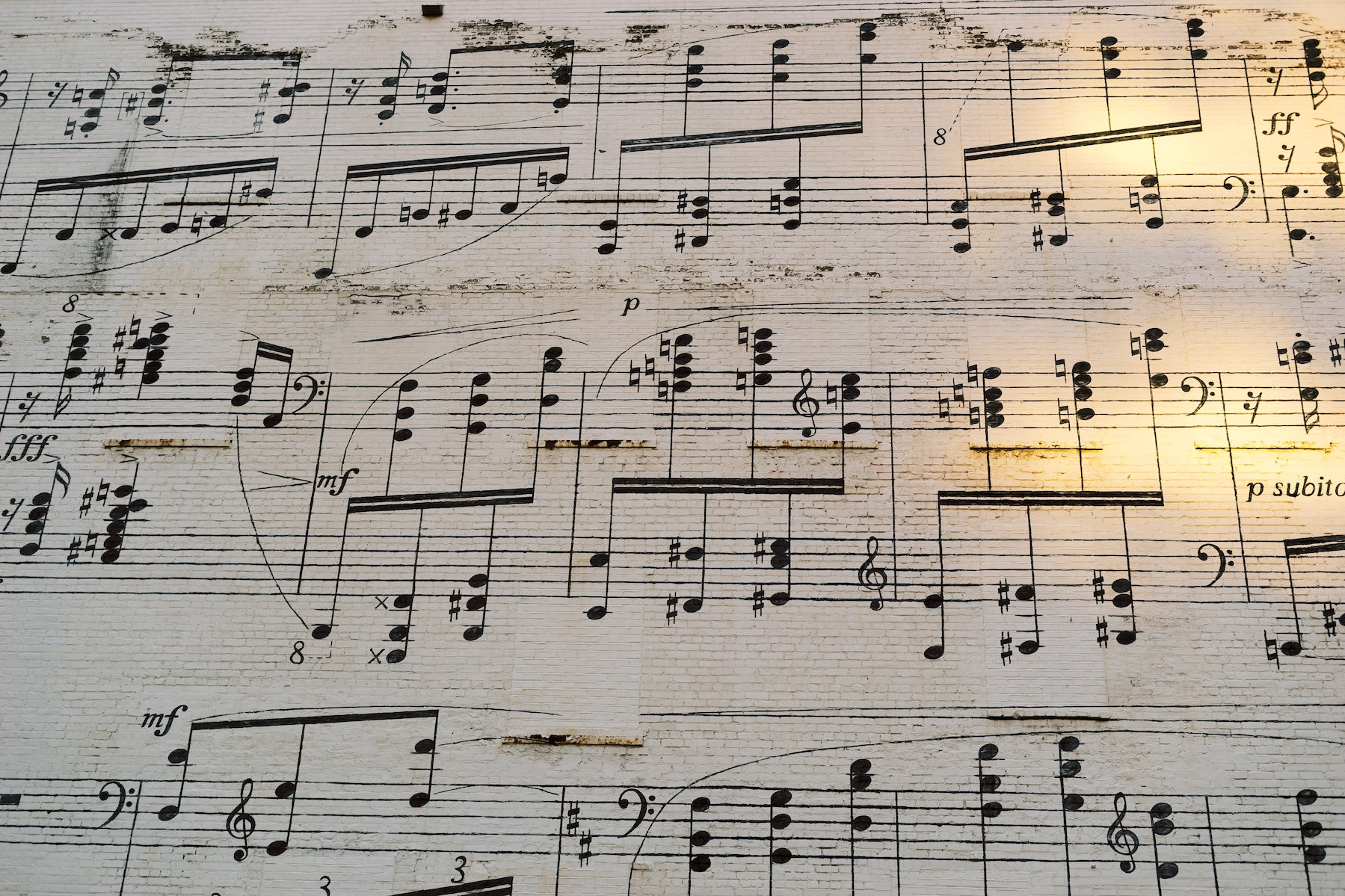
The third is certainly the most important interval in Western music because it's through this interval between two notes that we determine if a chord is major or minor.
The Third Interval
The word Third can designate two things:
- either it corresponds to an interval, that is a distance between two notes
- or it corresponds to a way of naming a note in a chord.
Finding the Third Interval Thanks to Note Names and Our Ear!
To find a note distant by a third from another, we can use note names to count, it works every time. We must count 3 notes, the word Third coming from the number “3”.
For example:
- The third starting from C is E, indeed we count 1- C, 2-D, 3-E.
- The third starting from Bb is D, indeed we count 1- Bb, 2-C, 3-D.
- The third starting from G is B, indeed we count 1- G, 2-A, 3-B.
Depending on the type of third we’re looking for, we must add a sharp (#) or a flat (b) to obtain it. There are 2 types of thirds: the minor third or the Major third. How to know if we should add a sharp or flat to obtain one or the other? It’s your ear that must tell you! Indeed we commonly hear:
- The Major third sounds happy, joyful, optimistic..
- The minor third sounds sad.
Let’s take two examples where you’d be looking for a note distant by a third from another by counting 3 notes apart with note names and then adjusting the third with a sharp or flat depending on what your ear tells you:
- Imagine you’re looking for the note distant by a minor third from F. You count 3 notes: 1-F, 2-G, 3-A. The third of F is an A. But if you play an F and an A at the same time, your ear will tell you it’s a rather joyful chord.. Indeed, the A is distant by a Major third from F… To have the minor third of F, you must lower the A with a flat. Ab is located at a minor third from F.
- Imagine you’re looking for the note distant by a Major third from E. You count 3 notes: 1-E 2-F 3-G. The third of E is a G. But if you play an E and a G at the same time, your ear will tell you it’s a rather sad chord.. Indeed, the G is distant by a minor third from E. To have the Major third of E, you must raise the G with a sharp. G# is located at a Major third from E.
Finding the Third Interval by Counting Half-Steps Between Notes!
Another way to find intervals of major and minor thirds between notes is to count the number of half-steps that separate them. The half-step is the smallest possible distance between 2 notes, it also corresponds to the distance between 2 successive keys on the piano.
All notes of the scale are separated by a whole step, with the exception of two intervals that are separated by only a half-step:
- E —> F
- and B —> C
You’ll note that these two intervals logically correspond to the places on the piano keyboard where we observe a succession of 2 white keys, without a black key to separate them.
The minor third corresponds to the distance between 2 notes of 3 half-steps (more classically we say that the minor third is 1 tone and 1 half-step).
The Major third corresponds to the distance between 2 notes of 4 half-steps (more classically we say that the Major third is 2 tones).
Knowing How to Find Thirds Allows You to Build Music Chords!
Knowing how to find notes distant by thirds, minor or major, is very important because music chords are created by stacking notes by thirds. Indeed, a major chord for example is a stack of 3 notes distant by a Major third (4 half-steps) and a minor third (3 half-steps)
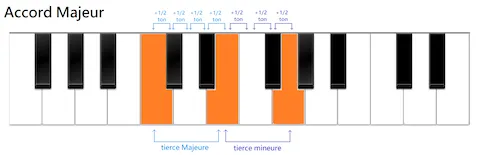
If you know how to find notes distant by thirds, then you’re able to build music chords. To accompany songs on piano or to compose, knowing how to build chords is very useful.
The Third in a Chord
The notes that compose a chord are named like the interval that separates them from the note that gives the chord its name (also called the fundamental note). For example, the third of the C Major chord is E. Indeed, the C Major chord uses C, E (its third) and G (a major third above E).
The third is certainly the most important interval in Western music because it’s through this interval between two notes that we determine if a chord is major or minor. The majority of Western musical works are based on a chord. The color of this chord (major or minor) gives its atmosphere to the work of which it’s the pillar. If for example we say that a musical work is in the key of E minor, it means that the main chord of the piece is the E minor chord.
The Particularity of the “Picardy Third”
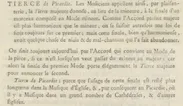
Finishing a piece on a Picardy third means finishing a minor piece with a major chord. For example, composing an entire piece around the C minor chord (containing C-Eb-G) and finishing it with a C Major chord (containing C-E-G). The major color of the last chord, happy and joyful, will create a strong contrast with the sad color of the piece based on a minor chord. This creates a surprise, opening a minor piece with a touch of optimism…
In his music dictionary, Jean-Jacques Rousseau describes the Picardy third thus: